
What to Automate First
A Decision Framework for Business Owners
The Framework for Deciding What to Automate First
How to prioritise automation investments so they build on each other
A business we worked with spent four months building an automated onboarding sequence. By the end, new leads were being tagged by industry, dropped into a nurture workflow, and receiving a series of emails — all without a team member touching anything.
The sequence ran cleanly. The problem was that nobody had agreed on what a qualified lead actually looked like. The qualification criteria changed depending on who you asked. The tagging logic reflected one person’s interpretation. The email content had been written for a customer profile that turned out to be inaccurate.
Automating the process didn’t fix any of that. It made the process faster, which meant the flawed assumptions were tested at scale before anyone caught them.
This is a more common situation than most businesses realise. The automation works. The results don’t improve. And the reason has nothing to do with the technology.
Why Sequence Matters More Than Selection
Most conversations about automation start with the same question: what can we automate? Teams walk through their processes, identify the slow or frustrating parts, and start looking for tools.
The question is reasonable. The sequencing that tends to follow is often not.
It’s common to see businesses automate the most visible problem rather than the one creating the most downstream friction. The visible problem gets attention because it’s the one people complain about in meetings. The downstream problem gets ignored because it only becomes apparent once you’ve built on top of it.
A more useful starting question is: which automation creates leverage for everything that comes after it? That reframe tends to produce a completely different priority list — and a different set of outcomes.
What Happens When You Automate Before You're Ready
Automating a process that isn’t ready for automation is a well-documented problem. Less documented is why it keeps happening across businesses of every size and sector.
Three patterns appear consistently.
A process with flaws becomes a faster process with flaws. If your lead qualification criteria are inconsistent, automating the routing doesn’t resolve the inconsistency — it processes inconsistent decisions at higher volume. The error rate doesn’t change. The scale does.
Decisions that vary by person become automated variations. When a process relies on judgment calls that different team members handle differently, the automation reflects one version of that judgment and applies it universally. Edge cases that an experienced team member would catch get handled the same way as straightforward ones.
Poor data produces unreliable outputs. Automation is downstream of data quality. A workflow built on a CRM with duplicate contacts, inconsistent field values, or missing information inherits every one of those problems. The workflow doesn’t fix the data — it runs on it.
The cumulative effect of all three is what some teams call automation debt: a compounding set of operational problems created by building on foundations that weren’t ready. Unpicking it is considerably harder than addressing those foundations before you started.
The Five Stages of Automation Maturity
Automation maturity moves through five stages. Most businesses that run into persistent problems have attempted stage three before completing stage one.
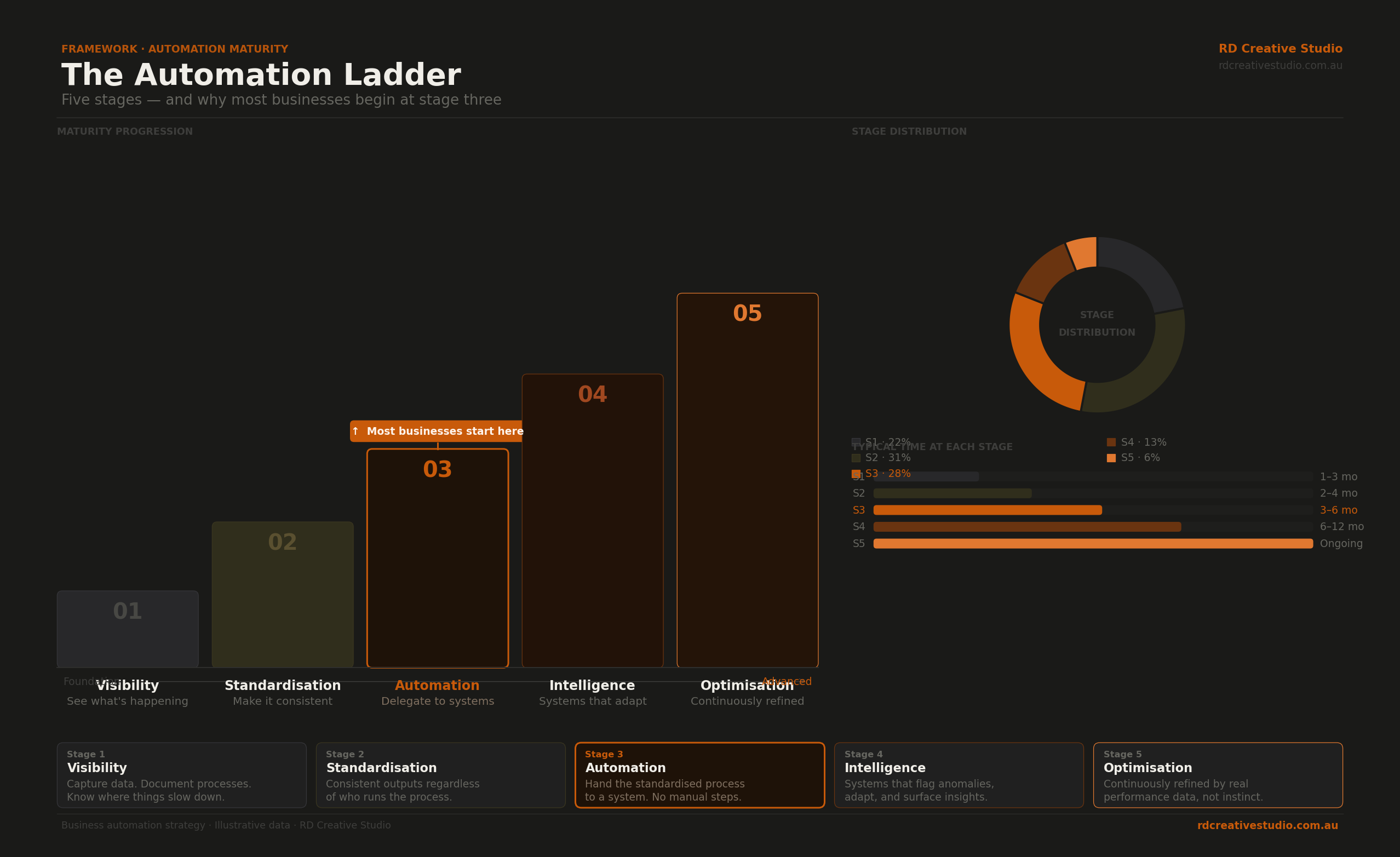
Stage 1 — Visibility. You can see what is actually happening. Data is captured. Processes are documented. You know where things slow down and where decisions are being made inconsistently.
Stage 2 — Standardisation. The process produces the same result regardless of who runs it. Decision criteria are defined. The output is predictable enough that a new team member could follow it and reach a consistent outcome.
Stage 3 — Automation. The standardised process is handed to a system. It runs without manual intervention because it no longer requires human judgment at each step.
Stage 4 — Intelligence. The system adapts based on patterns. It flags anomalies, surfaces insights, and makes recommendations. This is where AI tools add genuine value — as a layer on top of consistent process, not a substitute for it.
Stage 5 — Optimisation. The automated system is refined continuously based on real performance data.
The gap between stages one and three is where most automation problems originate. Teams reach for stage three because that’s where the efficiency gains are visible. But stage three built on an incomplete stage one is, in practice, a reliable way to scale the problems that already exist.
Three Questions to Ask Before Committing to Any Automation
These aren’t a checklist to work through quickly. They’re a filter. An automation that can’t answer all three clearly probably isn’t ready to build.
Does this create infrastructure that future automations rely on?
Some automations solve an isolated problem. Others create the foundations for a dozen subsequent workflows. A well-structured CRM with clean, consistent data doesn’t feel particularly exciting. But without it, automated lead routing, nurture sequences, and reporting workflows are all significantly less reliable.
Building the data foundation first doesn’t just solve a data quality problem — it makes everything downstream cheaper and faster to build. The question to ask: if we build this, what does it enable next?
Can you reverse it cleanly if the logic turns out to be wrong?
Automations vary significantly in how easily they can be corrected. An internal task routing workflow that misfires can be turned off and adjusted without external consequences. An automated customer communication that sends the wrong message for three months cannot be unsent.
Reversibility affects how much testing and validation an automation needs before deployment. Low-reversibility automations warrant considerably more scrutiny at the design stage — and should carry a documented rollback plan from day one.
What is the operational impact if this breaks outside business hours?
Some automations fail quietly — a tag doesn’t apply, a report doesn’t generate. Someone notices on Monday morning and fixes it in twenty minutes. Others fail in ways that affect customers, revenue, or contractual obligations before anyone in the business is aware.
The failure mode matters as much as the function. Automations with significant downside risk need human oversight built into the design, not added later when something goes wrong at an inconvenient time.
How to Sequence Your Automation Investments
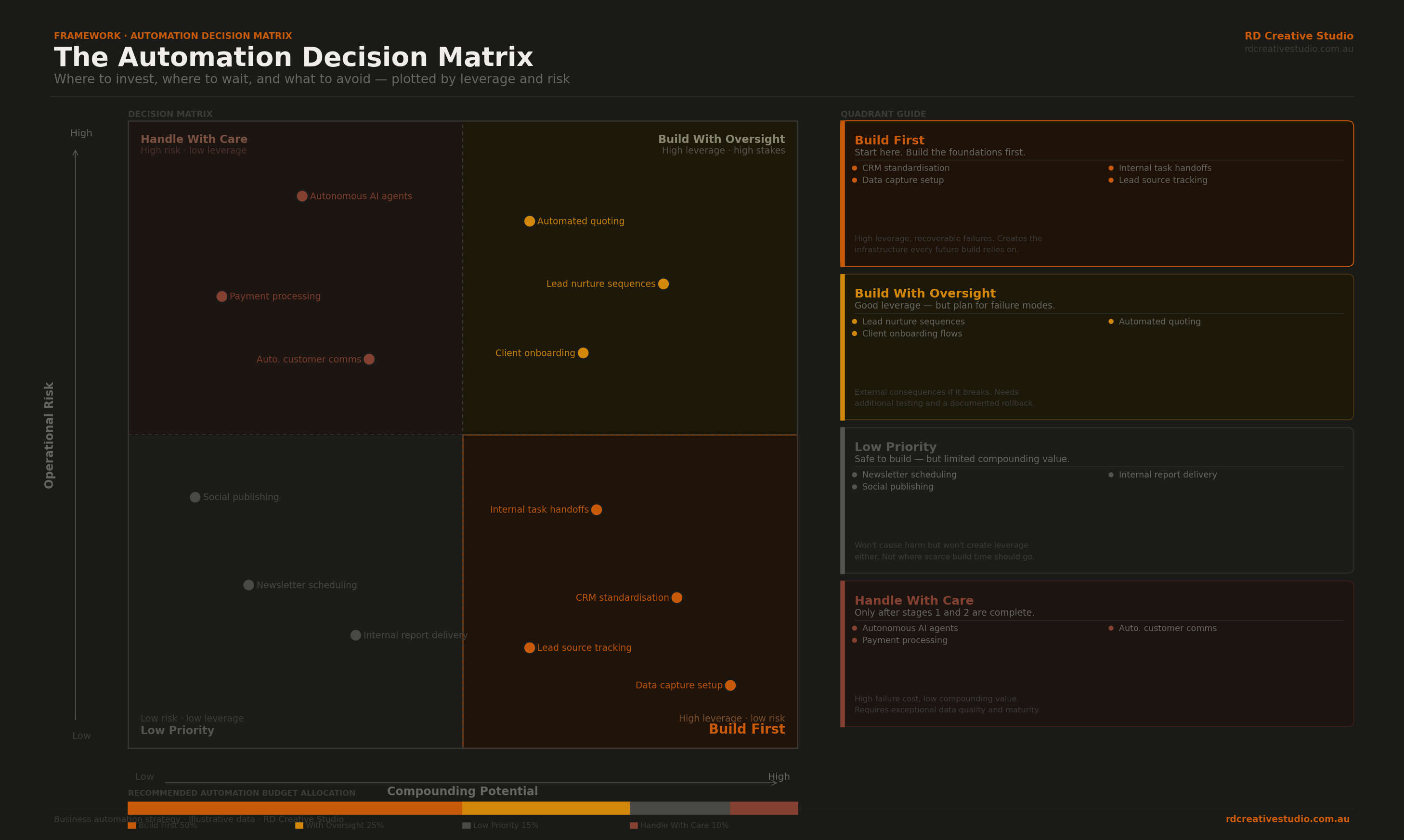
Given the three questions above, a practical sequence for most businesses looks something like this.
Data capture and CRM hygiene first. Before automating any process that depends on customer data, the data needs to be reliable. Consistent field values, clear ownership, and a shared definition of what different records represent. Unglamorous work. High leverage.
Process standardisation before automation. Document how the process runs today. Define what decisions get made and by whom. Run it manually long enough to understand the edge cases. Then automate the standardised version — not an idealised version of how you’d like it to work.
Internal handoffs before customer-facing flows. Automated task assignments, internal notifications, and file routing fail in ways that are recoverable. A workflow that misdirects an internal task can be corrected without anyone outside the business noticing. Build confidence in your internal automation before extending it outward.
Lead capture and nurture once the foundations are solid. Automated lead workflows become meaningfully more reliable when your CRM is clean and your qualification criteria are agreed and consistent. The sequence matters here more than almost anywhere else.
Reporting and operational dashboards next. Once data flows consistently, automated reporting gives leadership accurate visibility without manual compilation. This is often where the return on earlier foundation work becomes most visible.
Decision support tools, carefully. AI-assisted scoring, predictive tagging, and recommendation engines work well when the data feeding them is clean and the processes they support are consistent. They don’t compensate for weak foundations — they amplify whatever is already there.
Which Automations to Delay — and What to Do Instead
AI agents, autonomous workflows, and fully orchestrated multi-system pipelines are improving quickly. The case for building them is getting easier to make. For many businesses, the timing is still premature.
Complex AI workflows require clean data, standardised processes, and enough operational visibility to know when the system is producing bad outputs. Without those conditions, the workflow doesn’t become intelligent — it becomes an automated source of errors that runs continuously, without anyone catching them in time.
A practical readiness test: can you describe, in specific and consistent terms, how a human completes this task today? If the answer varies depending on who you ask, or includes phrases like ‘it depends’ or ‘usually, but sometimes’ — the process isn’t ready for autonomous handling. The right next step is standardisation.
That’s not a reason to delay indefinitely. It’s a diagnosis. It tells you exactly what to address before you build.
A Scoring Framework for Prioritising Automation Projects
Use this before committing to any automation build. Score each criterion from 1 (low) to 5 (high). The total guides where to invest first.
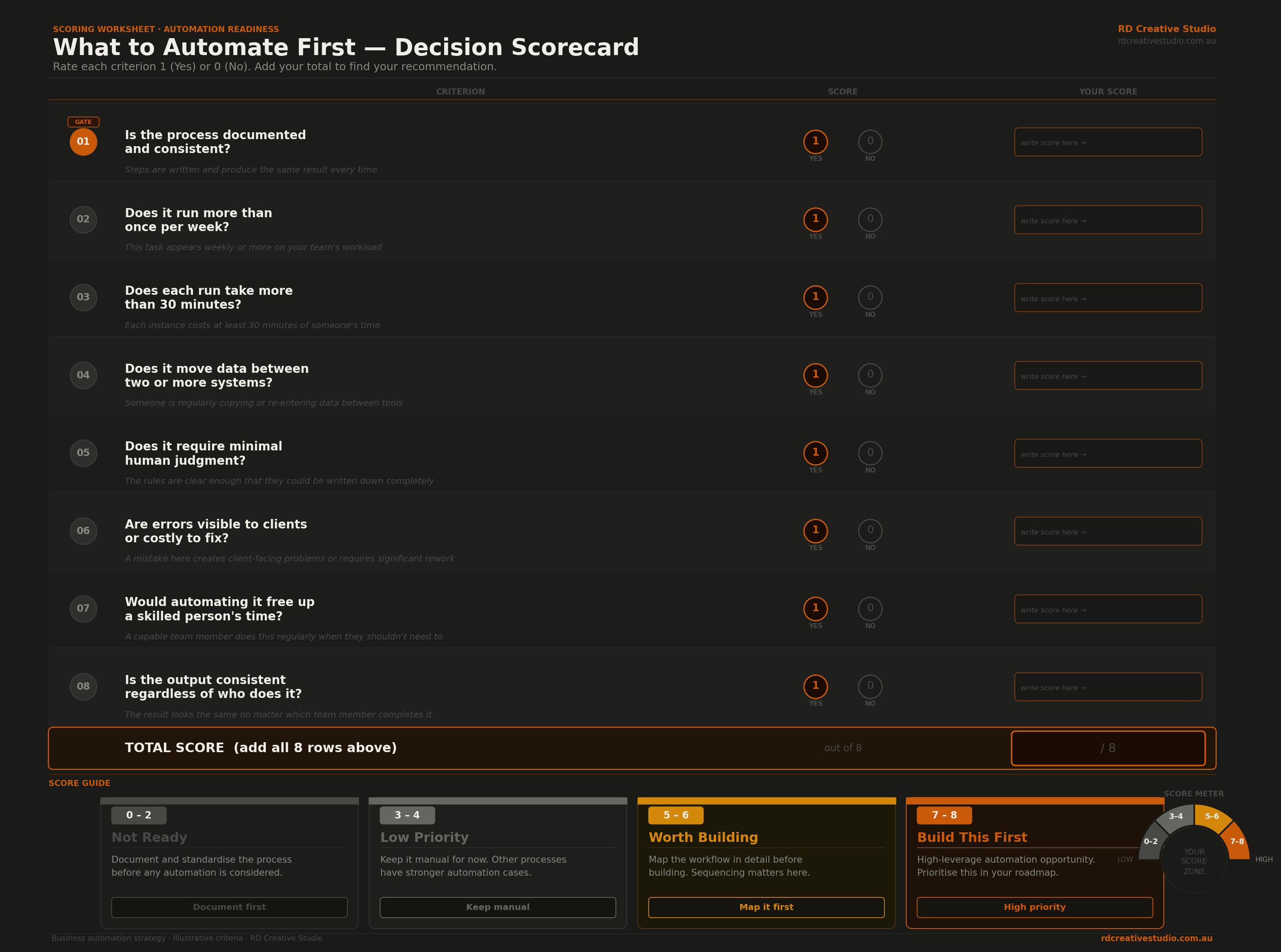
| Criterion | Score (1–5) | What to Evaluate |
|---|---|---|
| Compounding Potential | /5 | Does this automation make future automations easier to build or more reliable to run? |
| Reversibility | /5 | Can you roll it back cleanly if the logic is wrong? |
| Operational Risk | /5 | How significant is the failure mode? Score 5 for low-risk, quiet failures. |
| Process Maturity | /5 | Has this process been standardised and run consistently by humans first? |
| Data Quality | /5 | Is the data feeding this automation clean, complete, and consistent? |
| Frequency | /5 | How often does this process run? Higher frequency = higher return on investment. |
| Time Saved | /5 | Is the time recovered meaningful — hours, not minutes? |
| Cross-Team Impact | /5 | Does this reduce friction across more than one function? |
Scoring Guide
| Total Score | Recommended Action |
|---|---|
| 32–40 | High priority. Build with standard testing and monitoring. |
| 22–31 | Reasonable case. Build with closer oversight and a clear rollback plan. |
| 12–21 | Address the low-scoring criteria first. Revisit when foundations are stronger. |
| Below 12 | Not yet. The process or data quality isn’t ready. |
What Good Automation Actually Looks Like
The businesses that get the most from automation aren’t the ones that have automated the most. They’re the ones whose systems have become progressively easier to operate as the business has grown.
That’s a different objective than most teams are optimising for. Most automation decisions are driven by what’s slow, what’s frustrating, or what a software vendor is demonstrating at a conference. Those are reasonable data points. They’re not a strategy on their own.
The compounding value of automation comes from sequencing. Each well-placed automation makes the next one easier to build and more reliable to run. Each poorly-placed automation introduces friction that subsequent builds have to work around — often invisibly, until enough of it has accumulated to cause a real problem.
Starting with ‘which automation creates leverage for everything else?’ rather than ‘what can we automate?’ changes the order of decisions. It also tends to change the outcomes.

If you’re not sure which automation should come first in your business, that’s usually the right place to start the conversation. Book a clarity call with our team — we’ll help you work out what’s worth building, and in what order.